> For the complete documentation index, see [llms.txt](https://docs.dfinery.ai/developer-guide/llms.txt). Markdown versions of documentation pages are available by appending `.md` to page URLs; this page is available as [Markdown](https://docs.dfinery.ai/developer-guide/platform/android/integration.md).
# 연동하기
이 문서는 DFINERY SDK를 Android에 통합하는 방법을 다룹니다. DFINERY SDK를 설치하면 이벤트 분석 기능과 유저 프로필 기능 그리고 액션 기능이 제공됩니다.
더 자세히 알아보려면 [리소스 및 샘플](/developer-guide/common/resource-and-sample.md)을 참조하세요.
## 시작하기 전에
### 서비스 설정
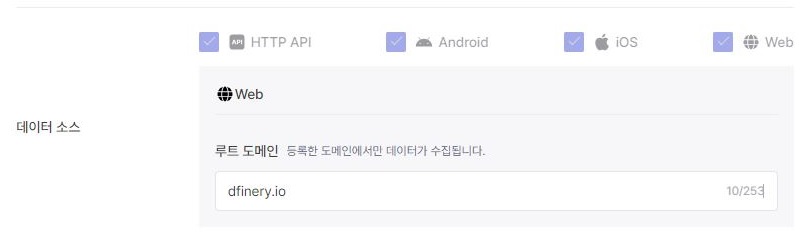
[DFINERY 콘솔](https://console.dfinery.ai/)의 서비스 관리/서비스 정보 페이지에서 데이터 소스 항목에 Android를 체크하셔야 합니다.
### 지원 정보
* 최소 지원 SDK : Android 4.4+ / API 19+
* 컴파일 SDK : 35
### 의존성
* [com.google.android.gms:play-services-appset](https://mvnrepository.com/artifact/com.google.android.gms/play-services-appset)
## SDK 설치
### 의존성 추가하기
앱에서 DFINERY SDK의 의존성을 적용하려면 다음 단계를 완료하세요.
#### 1. maven 의존성을 가져오기 위해 repositories 내에 `mavenCentral`을 추가합니다.
{% tabs %}
{% tab title="build.gradle (Gradle 3.5 이전)" %}
```groovy
allprojects {
repositories {
mavenCentral()
}
}
```
{% endtab %}
{% tab title="settings.gradle (Gradle 3.5 이후)" %}
```groovy
pluginManagement {
repositories {
mavenCentral()
}
}
dependencyResolutionManagement {
repositories {
mavenCentral()
}
}
```
{% endtab %}
{% endtabs %}
#### 2. 앱의 모듈 디렉터리 내에 있는 `build.gradle` 파일을 엽니다.
#### 3. dependencies에 [최신 버전의 DFINERY SDK](https://github.com/IGAWorksDev/dfinery-android-sdk/releases)와 필요한 요소에 대해 SDK 종속 항목을 추가합니다.
{% hint style="info" %}
DFINERY는 AppSetId를 수집하기 위해 [play-services-appset](https://developer.android.com/training/articles/app-set-id) 의존성을 필요로 합니다.
{% endhint %}
{% tabs %}
{% tab title="build.gradle" %}
```groovy
dependencies {
implementation 'com.google.android.gms:play-services-appset:16.0.2'
//Get the latest version from https://mvnrepository.com/artifact/com.igaworks.dfinery/android-sdk
implementation 'com.igaworks.dfinery:android-sdk:HERE_LATEST_VERSION'
}
```
{% endtab %}
{% tab title="build.gradle.kts" %}
```groovy
dependencies {
implementation("com.google.android.gms:play-services-appset:16.0.2")
//Get the latest version from https://mvnrepository.com/artifact/com.igaworks.dfinery/android-sdk
implementation("com.igaworks.dfinery:android-sdk:HERE_LATEST_VERSION")
}
```
{% endtab %}
{% endtabs %}
## SDK 초기화
### 초기화 하기
앱에서 DFINERY SDK를 초기화하려면 다음 단계를 완료하세요.
#### 1. Application을 상속한 객체를 생성합니다. 상속한 객체가 이미 있을 경우 해당 객체를 사용합니다.
{% tabs %}
{% tab title="Java" %}
```java
public class BaseApplication extends Application
```
{% endtab %}
{% tab title="Kotlin" %}
```kotlin
class BaseApplication: Application()
```
{% endtab %}
{% endtabs %}
#### 2. Application을 상속한 객체에서 [onCreate()](https://developer.android.com/reference/android/app/Application#onCreate\(\)) 메소드를 Override 합니다.
{% tabs %}
{% tab title="Java" %}
```java
@Override
public void onCreate() {
super.onCreate();
}
```
{% endtab %}
{% tab title="Kotlin" %}
```kotlin
override fun onCreate() {
super.onCreate()
}
```
{% endtab %}
{% endtabs %}
#### 3. onCreate() 메소드 내에 다음 코드를 작성합니다.
> Service ID는 [DFINERY Console](https://console.dfinery.ai/)의 `서비스 관리/서비스 정보/Key 정보/서비스키` 경로에서 확인이 가능합니다.
{% tabs %}
{% tab title="Java" %}
```java
Dfinery.getInstance().init(this, "{YOUR_SERVICE_ID}");
```
{% endtab %}
{% tab title="Kotlin" %}
```kotlin
Dfinery.getInstance().init(this, "{YOUR_SERVICE_ID}")
```
{% endtab %}
{% endtabs %}
다음 코드 스니펫은 초기화 작성 완료 시의 예를 보여줍니다.
{% tabs %}
{% tab title="Java" %}
```java
public class BaseApplication extends Application{
@Override
public void onCreate() {
super.onCreate();
Dfinery.getInstance().init(this, "{YOUR_SERVICE_ID}");
}
}
```
{% endtab %}
{% tab title="Kotlin" %}
```kotlin
class BaseApplication: Application(){
override fun onCreate() {
super.onCreate()
Dfinery.getInstance().init(this, "{YOUR_SERVICE_ID}")
}
}
```
{% endtab %}
{% endtabs %}
#### 4. AndroidManifest.xml에 작성한 Application을 등록합니다.
```xml
```
#### 5. AndroidManifest.xml에 필요한 권한을 추가합니다.
```xml
```
### 구글 광고 ID 설정하기(선택사항)
Google 광고 ID를 수집하기 위해선 `setGoogleAdvertisingId()` 메소드를 통해 수동으로 설정해야합니다.
{% hint style="warning" %}
Google 광고 ID 수집은 사용자의 명시적 동의가 필요합니다. [Google Play 개인정보처리방침 요구사항](https://support.google.com/googleplay/android-developer/answer/6048248)에 따라 광고 ID 수집 전 반드시 사용자 동의를 획득해야 합니다.
{% endhint %}
#### 1. 앱의 모듈 디렉터리 내에 있는 `build.gradle` 파일을 엽니다.
#### 2. dependencies에 [광고 ID를 수집하기 위해 필요한 종속 항목](https://developers.google.com/android/guides/setup)을 추가합니다.
{% tabs %}
{% tab title="build.gradle" %}
```groovy
dependencies {
implementation 'com.google.android.gms:play-services-ads-identifier:18.0.1'
}
```
{% endtab %}
{% tab title="build.gradle.kts" %}
```groovy
dependencies {
implementation("com.google.android.gms:play-services-ads-identifier:18.0.1")
}
```
{% endtab %}
{% endtabs %}
#### 3. AndroidManifest.xml에 필요한 권한을 추가합니다.
```xml
```
#### 4. `setGoogleAdvertisingId()` 메소드를 통해 광고 ID를 설정합니다.
{% hint style="success" %}
광고 ID 수집 로직은 별도의 스레드에서 동작해야 합니다. 아래 코드 스니펫은 Thread를 생성하여 동작했지만, 필요에 따라 다른 방법(AsyncTask, 코루틴 등)을 사용하여도 됩니다.
{% endhint %}
{% tabs %}
{% tab title="Java" %}
```java
new Thread(new Runnable() {
@Override
public void run() {
try {
AdvertisingIdClient.Info idInfo = AdvertisingIdClient.getAdvertisingIdInfo(getApplicationContext());
DfineryProperties.setGoogleAdvertisingId(idInfo.getId(), idInfo.isLimitAdTrackingEnabled());
} catch (Exception e) {
e.printStackTrace();
}
}
}).start();
```
{% endtab %}
{% tab title="Kotlin" %}
```kotlin
Thread {
try {
val idInfo = AdvertisingIdClient.getAdvertisingIdInfo(
applicationContext
)
DfineryProperties.setGoogleAdvertisingId(idInfo.id, idInfo.isLimitAdTrackingEnabled)
} catch (e: Exception) {
e.printStackTrace()
}
}.start()
```
{% endtab %}
{% endtabs %}
## SDK 설정
SDK 초기화 시에 로그 활성화 등의 옵션을 설정할 수 있습니다.
### 로그 활성화 하기
로그 활성화는 DFINERY의 설정을 적용하는 DfineryConfig를 사용하여 설정 가능합니다. DfineryConfig는 `init()` 메소드 호출 시에 파라미터로 넣어 적용하거나 `res/values/dfinery.xml`을 사용하여 설정 할 수 있습니다.
```java
setLogEnable(boolean enable)
```
* 첫 번째 인자인 `enable`은 로그를 표시할지 말지 설정하는 값입니다. 기본값은 `false`입니다.
{% hint style="success" %}
`BuildConfig.DEBUG` 값을 넣어 디버그 모드일때만 로그가 출력 되고 배포시에는 출력되지 않게끔 설정할 수 있습니다.
{% endhint %}
{% tabs %}
{% tab title="Java" %}
```java
DfineryConfig config = new DfineryConfig.Builder()
.setLogEnable(true)
.build();
Dfinery.getInstance().init(this, "{YOUR_SERVICE_ID}", config);
```
{% endtab %}
{% tab title="Kotlin" %}
```kotlin
val config = DfineryConfig.Builder()
.setLogEnable(true)
.build()
Dfinery.getInstance().init(this, "{YOUR_SERVICE_ID}", config)
```
{% endtab %}
{% tab title="dfinery.xml" %}
```xml
true
```
{% endtab %}
{% endtabs %}
### 로그 레벨 변경하기
로그 레벨은 Dfinery의 설정을 적용하는 DfineryConfig를 사용하여 설정 가능합니다. DfineryConfig는 `init()` 메소드 호출 시에 파라미터로 넣어 적용하거나 `res/values/dfinery.xml`을 사용하여 설정 할 수 있습니다.
{% hint style="info" %}
로그 레벨 값은 [`android.util.Log`](https://developer.android.com/reference/android/util/Log#constants_1)의 상수 값의 정의를 따릅니다.
{% endhint %}
```java
setLogLevel(int logLevel)
```
* 첫번째 인자인 `logLevel`은 로그 표시 레벨을 설정하는 값입니다. 기본값은 `Log.ERROR(6)` 입니다.
{% tabs %}
{% tab title="Java" %}
```java
DfineryConfig config = new DfineryConfig.Builder()
.setLogLevel(Log.DEBUG)
.build();
Dfinery.getInstance().init(this, "{YOUR_SERVICE_ID}", config);
```
{% endtab %}
{% tab title="Kotlin" %}
```kotlin
val config = DfineryConfig.Builder()
.setLogLevel(Log.DEBUG)
.build()
Dfinery.getInstance().init(this, "{YOUR_SERVICE_ID}", config)
```
{% endtab %}
{% tab title="dfinery.xml" %}
```xml
2
```
{% endtab %}
{% endtabs %}
## 완료
SDK 설치 및 초기화가 완료되었습니다.